
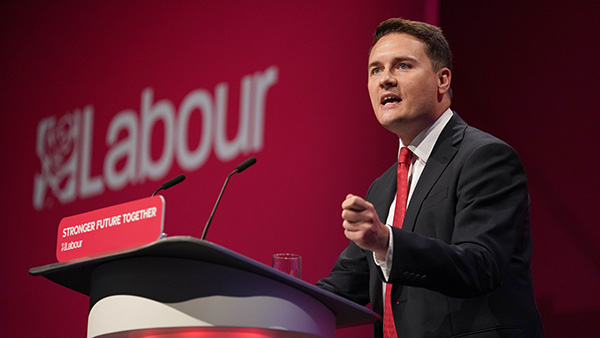
Wes Streeting’s record is not one of change or reform, but of political opportunism and hostility to the health service he was trusted to protect. Keep Our NHS Public responds to his resignation
Wes Streeting leaves the office of Secretary of State for Health and Social Care presenting himself as the man who ‘told the truth’ about the NHS and took on vested interests. In reality, his tenure has been defined by bullying and demoralisation, privatisation, chaos and failure. Far from rescuing the NHS after years of Conservative underfunding, Streeting accelerated many of the same destructive trends that brought the service to crisis point in the first place.
For campaigners fighting to defend a publicly provided NHS, his record is not one of courage or reform. It is one of political opportunism combined with an ideological hostility to the very model he was entrusted to protect.
The central political fraud of Streeting’s time in office was his repeated insistence that the NHS did not primarily need more funding, but instead ‘reform’, ‘productivity’ and’partnership with the private sector’. That framing echoed the language used for years by Conservatives to justify marketisation and outsourcing. It ignored the reality acknowledged across the health policy world: the NHS inherited by this parliament after more than a decade of historic underinvestment was one ofcrumbling estates, staffing shortages and collapsing morale.
Instead of rebuilding confidence in public provision, Streeting repeatedly claimed the NHS was ‘broken’. It was a calculated political choice with serious consequences. The NHS is not broken: it has been battered by austerity, fragmentation and chronic underfunding. Staff who carried the service through the pandemic heard a Health Secretary attacking the institution rather than defending it.
At precisely the moment the NHS needed stability, Streeting imposed one of the most reckless reorganisations in its history. The abolition of NHS England was announced without detailed plans, meaningful consultation, legislative preparation or credible risk assessment. Integrated Care Boards were then subjected to brutal budget cuts and forced mergers at speed and 25,000 job losses. Trusts are forced to cut tens of thousands more jobs. The result has been chaos across the service, clinical and organisational expertise destroyed and staff morale driven even lower.
Privatisation and Palantir
Streeting’s answer to every NHS crisis was more private sector involvement. He argued that Labour would use private providers “more efficiently” than the Conservatives. His allies and advisers were even more explicit. Alan Milburn, resurrected from the Blair period and one of Streeting’s key influences, declared that Britain must stop seeing healthcare as centred on ‘a single institution that we happen to call the National Health Service’ and instead view it as an ‘ecosystem’ of private firms, tech companies and commercial providers – tagging on ‘the public sector’ at the end.
Under Streeting, privatisation was not confined to elective operations. His 10 Year Health Plan extends it into commissioning, workforce planning, digital infrastructure, estate development and long-term strategy itself. His ‘partnership’ with the private hospital sector committed roughly £2.5 billion of NHS funding to private providers in exchange for promised waiting-list reductions. Yet there is no ‘spare capacity’ in the private sector: private providers depend heavily on NHS-trained staff, NHS infrastructure and NHS funding. They demand extra funding to create that capacity. Yet every pound diverted into private provision weakens the public system further.
Most alarming of all was Streeting’s embrace of Palantir, which reflects a serious threat to the future of the NHS. Palantir is not a neutral public service partner. It is a US surveillance-tech corporation built on military, intelligence and border-control contracts. Its business model depends on the extraction and control of data at enormous scale, and potentially used in the UK for state surveillance of migrants, just as it enables ICE in the USA. Campaigners warned repeatedly that placing the NHS’s federated data platform into Palantir’s hands risked embedding corporate control deep within the health service. Streeting ignored those warnings.
The political context to this matters. Peter Mandelson was Streeting’s close mentor. Mandelson’s consultancy, Global Counsel, worked with Palantir as a client. Streeting surrounded himself with advisers and mentors from the Blair era who remained deeply committed to market-based healthcare reform. Despite widespread public concern, he showed no willingness to revisit or terminate the Palantir relationship. Instead, he championed ‘digital transformation’ in language that often sounded indistinguishable from Silicon Valley sales pitches.
For many campaigners, Palantir symbolises the wider Streeting project: transferring power, resources and influence away from democratic public institutions and towards private corporations operating behind the language of ‘innovation’.
Failure to stop the frontline crisis
Meanwhile, on the NHS’s actual frontline crises, Streeting failed catastrophically. The most shocking scandal in modern NHS history, avoidable deaths linked to delayed emergency care, was barely acknowledged. More than 16,000 avoidable deaths annually are now associated with delays in urgent and emergency treatment, yet Streeting consistently reduced the crisis to questions of “management” and “efficiency”, pushing blame toward NHS workers and minimising the consequences of under-capacity, understaffing system overload and the state of social care.
He claims his crowning success to be waiting lists, but they remain stubbornly high at 7.1 million. Labour’s modest reductions have significantly depended on removing patients from lists by ‘validation’ and ‘cleansing’ data, rather than increasing treatment capacity. At the current rate, progress remains painfully slow because the underlying issue has never been addressed: the NHS requires major sustained investment to improve.
Instead, Streeting postponed key hospital rebuilding commitments well into the 2030s, despite Labour’s manifesto promises. He failed to produce a serious solution to the social care catastrophe. He clashed with the BMA and GPs, and deepened conflict with doctors and NHS staff rather than rebuilding trust. Thousands more GPs are still needed while trained doctors face unemployment because practices lack the funding to hire them.
“Who do you work for, Wes?”
And hanging over all of this are serious questions about political influence and private interests.
Streeting accepted more than £200,000 in donations linked to individuals and organisations with healthcare-related commercial interests, according to research by campaigners and analysis of parliamentary declarations. Among them were donors connected to private healthcare recruitment and investment firms with substantial stakes in the expanding health market. Whether or not explicit favours were exchanged misses the wider point entirely: Streeting governed consistently in ways that aligned with corporate healthcare interests and against the rebuilding of publicly provided NHS capacity.
His defenders will say he was “realistic” about the pressures facing the NHS. But realism would have meant confronting the scale of underfunding honestly. It would have meant investing in public provision, rebuilding morale, retaining staff and reversing fragmentation. Instead, Streeting doubled down on the failed assumptions that have undermined the NHS for decades: market competition, outsourcing, managerial churn and corporate partnership.
Now, having helped entrench those policies, he resigns claiming he can no longer support Keir Starmer’s direction. For those who believe in a universal, publicly provided NHS free from corporate control, his departure is not the loss of a reformer. It is the end of a deeply damaging chapter.
What remains is to continue to push for serious change for our health service, whoever Streeting’s successor is.
Brilliant synopsis!
Absolutely. It’s the old need we always have to face up to:
Speaking Truth to Power
This item should be sent every Labour mp and every secretary of ever Labour constituency party since the rank and file members have right to vot. Also it should put in front of Starmerse-mail since in the “King’s speech” ‘ govt would continue to remove NhS England , a continuation of of Streeting” privatisation “ project. If , Streeting is confirmed PM the whole country should remember that he was elected with a majority of 5 votes!!
Wes Streeting was a disaster for the NHS and will be a disaster for the country if he becomes the Labour leader. I was in hospital just after the Conservatives came to power in 2010 and the hospital was still running as it had before they came to power. I had a follow up operation 10 months later and noticed immediately the deterioration in the care. 10 months earlier there was a doctor’s round every day and a junior doctor available on the ward the whole time. After my second operation there were no doctor’s rounds. In fact there was an emergency and a lady needed a doctor urgently and it took a number of minutes to find one. I can only assume things have got much worse. I will not be voting Labour if Streeting becomes prime minister, he was one of Keir Starmer’s many mistakes.
Wes Streeting’s dismal record of “managing” the NHS certainly does not qualify him as Prime Minister.
An excellent analysis. I had not realised what a dangerous man Streeting was. Dangerous to public health.
I have always thought that he is a political ladder climber. Certainly he has done nothing for NHS.
His challenge to Kier Starmer is, at this time of national difficulty, is very poor timing but does he care. Hmmmm !
Yet another self serving politian. God help us if he becomes PM.
Keep Our NHS Public has a 20 year record deep understanding of the privatisation and downgrading of the NHS. Their clear showing of the disaster Wes Streeting has been shows him to be unfit for any office of importance. It also demonstrates the reason Keir Starmer and the Labour Party have to go.
Andy Burnham is the only politician polls show would beat Farage in an election. He has initiated integration of NHS and social care in Manchester.
The way forward for Labour, and for the UK is clear.
Streeting would destroy any chance of averting the authoritarian pathvAnerica has been lost to.
Save our NHS
I voted Labour because historically [up until 1997, and tony liars new labour] they worked for the working class, not for the epstein & media billionaire class. Now, as most of them take money from the epstein, crypto & media billionaires we have to perpetuate the, witch thatcher’s, scam and lies of privatisation. Worse, they use our tax money to pay for the bribes and the epstein billionaires tax breaks; when they give out a contract after being lobbied. So first we lose to a bribe and secondly with an overpriced, under delivered, perpetually renewed, contract.
Philip Hodkinson
We must remain ever vigilant. Sylvia McGinnis