
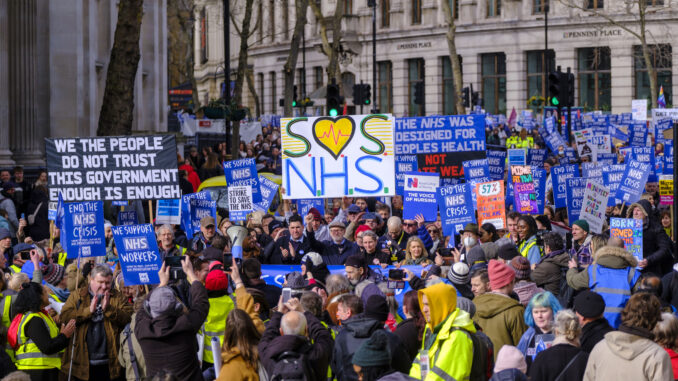
The successes and achievements of campaigners for over twenty years, set out here, show a consistent pattern: when communities organise, speak out, and sustain pressure, change happens. NHS campaigners have saved ten hospitals, defended local services, challenged national legislation, helped delay or stop closures, halted privatisation, restored NHS provision, and have shifted public debate about the future of healthcare. Numerous groups and alliances have played important roles and Keep Our NHS Public has been a constant presence throughout this work, supporting or coordinating action locally and leading at national level.
Click on the headings below to read summaries for each campaign win. Alternatively, download our comprehensive report [PDF] for both the summaries and detailed case studies:
Keep Our NHS Public and allied NHS campaigns across the UK have successfully resisted hospital downgrades and closures over the past decade and more. At Whittington Hospital (2009–2010), the Defend the Whittington Hospital Coalition forced a halt to closure plans, while at Lewisham Hospital (2012–2013), the Save Lewisham Hospital campaign mobilised the whole community and won decisive High Court and Court of Appeal rulings, preserving full services. In 2017, campaigns protected services at North Devon District Hospital Barnstaple, Glenfield Hospital Leicester, and Shropshire Community Hospitals through sustained local and national pressure.
Longer-running efforts included Ealing Hospital (2012–2019) and Charing Cross Hospital (2012–2019), where major reorganisation plans were eventually abandoned, securing both hospitals and key services. Liverpool Women’s Hospital (campaign to 2017, ongoing) remains open following opposition to merger proposals, while for Huddersfield Royal Infirmary (2014-2020), campaigners forced an abandonment of downgrade plans. The long-running campaign over Telford and Royal Shrewsbury A&E Services (c. 2011–2025) has so far delayed centralisation and kept both departments operating. All these demonstrate the sustained impact of coordinated community, legal and political action. Other campaigns, though not wholly successful, have slowed down closures and fought for alternative safety measures.
Several NHS campaigns including Keep Our NHS Public have successfully challenged privatisation, service cuts, and reorganisation in primary and community care. At Maghull GP Surgery, Merseyside (2007) local opposition halted privatisation plans, while Liverpool GP Surgeries (2014) saw campaigners challenge private provider SSP Health, leading to its replacement in some practices.
East London GP Surgeries (2014) were protected through strong community mobilisation by the Save Our Surgeries (SOS) campaign, and Out-of-Hours GP Services in North London (2016) remained in non-profit hands after plans for private provision were overturned.
Campaigners also secured reversal of cuts (2018) to Lewisham Child & Adolescent Mental Health Services (CAMHS) and partial gains for Lewisham and Greenwich Orthopaedic Services (2018), as well as saving Sheffield Walk-in and Minor Injuries Services (2018). Swindon GP Surgeries (2019) returned to NHS control after a private contract collapsed amidst publicised protests, while Southwark Children’s Mental Health Services (2019) saw major access improvements following campaigning.
In rural Dorset, the Swanage Ambulance Car (to 2021, ongoing monitoring) was retained after large-scale local mobilisation. More recently, North West London GP ‘Same Day Hub’ Plans (2024) were halted, and Newcastle Sexual Health Services (2023–2026) were brought back into NHS provision in 2026 after sustained pressure exposed failures in private delivery, underscoring the continued effectiveness of coordinated public, legal, and political resistance.
Campaigns across England have successfully blocked, reshaped or delayed attempts to privatise NHS services at scale.
2011-12: In Gloucestershire, plans to transfer nine community hospitals into a “social enterprise” were halted after legal action, keeping services and staff within the NHS. Campaign pressure and legal scrutiny
2014: An £800 million contract was steered away from a private provider towards an NHS consortium to provide Cambridgeshire and Peterborough Older People’s Services.
2016: Defending the Bristol Adolescent Mental Health Unit, plans to move services out of NHS control were dropped.
2015: West Sussex MSK (musculoskeletal) Orthopaedic Services were kept public after a decision to award a private contract was reversed.
2017: Learning from this, challenges to the privatisation of Greenwich Orthopaedic Services delayed the decision until the contract was amended to protect NHS provision.
2017: Sussex Sexual Health and Patient Transport Services were successfully challenged, leading to key services being retained or returned to public control.
2017: Nationally, NHS Professionals remained in public ownership after We Own It supported by KONP campaigners resisted privatisation proposals, demonstrating the effectiveness of coordinated legal, political, and public pressure in defending NHS provision.
2018: Judicial Review challenging the Department of Health and NHS England’s move to set up accountable care organisations (ACOs) in England.
NHS activism has also shaped national political debate and public accountability. Initiatives such as an electoral challenge to a sitting Health Secretary, a mass petition opposing the inclusion of the NHS in international trade deals, and an independent public inquiry into the Covid-19 pandemic have all helped bring issues of privatisation, funding, and health inequality into wider public view. These efforts show how campaigning can extend beyond defending individual services to influencing national policy, public discourse, and democratic scrutiny.
Alongside local and service-based campaigns, national organising has played a key role in shaping debate about the NHS and social care. This has included a judicial review in 2018 against the Government’s plans in impose a US-style ‘Accountable Care Organisation’ structure on the NHS; sustained opposition to major legislation such as the Health and Social Care Act 2012 and the Health and Care Act 2022; large-scale public demonstrations defending the NHS; and national conferences focused on social care, mental health, and pressures in general practice. Campaigning has also marked key moments such as the NHS’s 75th anniversary, helping to link celebration with critical discussion about its future. Together, these activities show how coordinated national action can influence public understanding, maintain political pressure, and connect frontline concerns with wider policy debates. You can explore these examples further below.
Keep Our NHS Public has played a central role in building broad national alliances to strengthen campaigning around the NHS and social care. In 2022, we launched the SOS NHS alliance, now the largest NHS campaigning coalition, bringing together over 50 sponsoring organisations including 18 national trade unions, helping to coordinate joint action, national demonstrations, and shared demands for renewed investment in our public NHS, pay justice for NHS staff and an end to privatisation. Prior to SOS NHS, Keep Our NHS Public members launched Health Campaigns Together in 2016, as a coalition of unions and campaign organisations. HCT merged with KONP in 2022 as the union-facing work of KONP. Keep Our NHS Public has also been central in establishing and supporting the End Social Care Disgrace campaign which, with other national organisations, is building a united voice calling for publicly provided, properly funded and accountable national care support and independent living service distinct from and where relevant working with the NHS.
Migrant Justice and Anti-Racist NHS Campaigning
Keep Our NHS Public has been actively engaged in local and national campaigning against migrant scapegoating and NHS charging policies, working alongside migrant rights organisations and trade unions to defend equal access to healthcare. In 2019, campaigning and public scrutiny contributed to wider challenges to hostile environment policies in the NHS, including concerns raised at trusts such as Barts Health, University Hospitals of Liverpool, Lewisham & Greenwich NHS Trust about the impact of migrant charging and exclusionary practices on patient access and safety.
A key moment in this work was the national event “NHS in Crisis: Migrants Not to Blame”, held in Soho in November 2025, which brought together campaigners, clinicians, and political speakers to argue that NHS pressures are driven by underfunding and privatisation rather than migration, and to challenge racist narratives around service demand.
This was followed in March 2026 by the “Migrants Make the NHS” bloc on the Together Alliance national demonstration in central London, organised with trade unions and allied groups, against racism and the rise of the far right. The Health bloc opposed divisive anti-migrant politics and explicitly highlighted the role of migrant workers in sustaining the NHS.
Together, these activities reflect an ongoing strand of campaigning focused on defending a universal, inclusive NHS, challenging discriminatory policy frameworks, and highlighting the essential contribution of migrant workers to health and social care in the UK.