
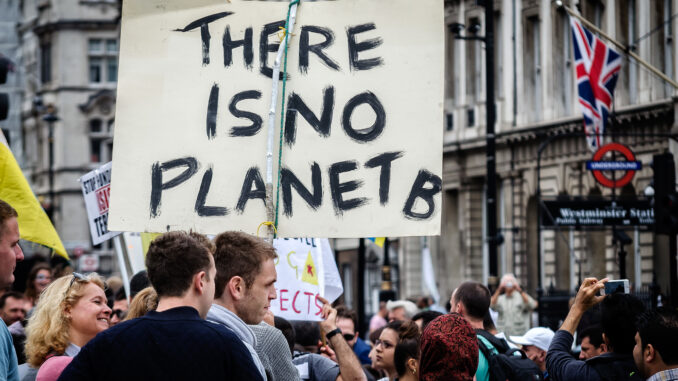
Climate change is dangerous for all of us and it is getting worse. Lucy Nichols explores the implications for the NHS and discusses how NHS campaigners can fight back
When it came into government in 2024, the Labour Party promised that it would not allow any new oil or gas fields to be built in the North Sea.
Then, in late October, came an announcement that the Government has approved a new gas field, Jackdaw, in the North Sea. Some clever manoeuvring by the gas company Adura, which owns and operates the Rosebank oil and gas field and the coming Jackdaw, means that the government is operating ‘legally’ in allowing this new gas field.
This is, however, another example of Labour failing to live up to past promises, and is indicative of the Government’s overall malaise on issues of the climate crisis. The Jackdaw gas field points to wider inaction on tackling the climate crisis, the brunt of which will ultimately be borne by all of us.
Climate breakdown is the number one threat to public health, and as NHS campaigners we should also be aware of the effects on our health service, even if this is not something often discussed or analysed.
Jackdaw – who profits?
The Government’s approval of Jackdaw comes despite protests from climate experts and activists, and many of Labour’s own MPs. Prime Minister Burnham has argued that the new gas field will “protect jobs” and “keep more houses warm this winter.” In reality, it is estimated that Jackdaw will create 27 new jobs and protect 273 – this comes amid a rapidly declining number of jobs in the UK oil and gas industry, with “employment halved from 441,000 in 2013 to 213,000 in 2023, despite hundreds of drilling licences being issued.”
The Government also argues that Jackdaw will contribute to energy security over the coming years and help the UK be more self-sufficient when it comes to energy security. Experts have, however, questioned just how economically and environmentally sensible the decision is. For example, Richard Sulley from the University of Sheffield is quoted by the Science Media centre as follows:
“Why approve the Jackdaw gas field? It makes no sense economically, it will create only 27 jobs, and some modest tax receipts for the Exchequer… It will do nothing for the cost of living, the volume extracted will be too small to have a material impact on the global markets. There’s no energy security benefit, it in fact keeps UK industries and consumers exposed to the international markets that set prices and the wills of foreign governments who can control the flow of resources.”
The campaigning group Stop Rosebank reports that if burnt, the gas produced at Jackdaw will release the same amount of emissions as the entire nation of Ghana, or half of what Scotland produces. It is clear that Jackdaw will not bring in many of the benefits claimed by the government but will certainly contribute to global warming and the climate crisis far more than Shell and Equinor – the two energy companies that own Adura – claim.
With this in mind, it is important to support campaigns against Jackdaw and Rosebank, the nearby oil field owned by the same corporations.
Climate change and the NHS
The climate crisis is not some far-away catastrophe but is happening now and is dangerous for all of us. The potential impacts of this crisis on the NHS have been explored in depth by various institutions, journals and government bodies.
They broadly explore likely outcomes of the climate crisis, the first being extreme weather events such as heatwaves or floods. The second is global warming, which is expected to reach 2°C by 2050.
Extreme weather events place additional pressure on the NHS in several ways, for example, pressure on mental health services: mental health-related hospital admissions, GP visits for mental ill-health and the need for mental health support all increase in areas affected by extreme weather events. Older people, people with pre-existing mental health conditions, healthcare workers and first responders are all at particular risk.
Extreme weather also creates service disruptions, for instance overheating hospitals caused by heatwaves, leading to operating theatres out of action, inpatients deteriorating, staff fainting, and lack of access to energy or water caused by flooding.
Heatwaves and flooding are expected to worsen and put the NHS under even greater strain because of global warming. If we do reach warming of 2°C by 2050, the British Medical Journal (BMJ) expects triple the number of heat-related hospital attendances, and 32% of UK hospitals to flood.
Furthermore, we saw huge numbers of heat-related deaths during the heat waves in the summer of 2026. In 2025, the NHS recorded 1504 heat-related deaths. In 2026, this number was almost double at 2877. As of March 2025, heat-related mortality cost the NHS in England £6.8 billion a year. In response to this, NHS England itself has the goal of reaching net-zero emissions and has put out various reports on how it plans to do so. However, without a clear, unified commitment to net-zero across government departments (linked to practical action), the NHS alone will struggle to make a difference even though it contributes 4-5% of the UK’s total carbon and greenhouse gas emissions.
Who is affected?
The Government itself reports that climate change will act to worsen the health inequalities already in place in the UK. The impacts of the climate crisis will have the most severe effects on children and young people; those with existing health conditions; occupational groups (such as farmers); people living in more deprived areas; ethnic minority groups and migrants and homeless people. Of course, many of these groups overlap, and the broad trend is that working-class people will be worst affected.
Health inequalities in the UK are already stark. We know, for instance, that migrants and undocumented people are often unable to access NHS care, or that Black women are three times more likely to die in childbirth than white women – and that the number of women dying during childbirth in general is already unacceptably high. Furthermore, the NHS crisis is worsening: new research estimates the number of avoidable deaths in England’s A&E departments, caused by delays in emergency care, to be 550 weekly–far more than the hitherto reported figure of 305–with more deaths expected the more overcrowded the department is. Deteriorating public health can be expected to pile extra pressure on the NHS.
A global crisis
The climate crisis is of course a global issue. The biggest polluters in the world are China and the United States, while the United States Military is the single largest institutional greenhouse gas emitter. Furthermore, according to the UN:
The wealthiest bear the greatest responsibility: the combined emissions of the richest one percent of the global population are larger than the combined emissions of the poorest 50 percent.
As we have seen, it is often the poorest that will be worst affected, while the rich benefit (at least in the short term before environmental disaster). We must exert maximum pressure on our own government to tackle UK emissions – the Jackdaw gas field undermines any claims from Prime Minister Burnham that the Government is truly committed to net zero.
It is clear that we are in a moment of deep crisis, and we have two scenarios in front of us. The first: we continue along the Government’s current path, with no extra funding for the NHS and no plan to tackle the climate crisis that recognises the urgency of the problem. Both these issues will worsen the longer they are allowed to continue, with climate-driven public health consequences set to overwhelm health service provision.
The second scenario is that something changes: the Government recognises the health dangers of the climate crisis and urgently enacts a plan for the NHS, so that the service is prepared for global warming and its effects, while giving absolute priority to investing in tackling climate change itself.
Keep Our NHS Public will continue to push for the latter. We know that the NHS can be one of the best healthcare services in the world, and that it must be equipped to deal with a rapidly changing world. There is therefore much common ground between health and environmental campaigners and building strong links should be part of our campaigning strategy.
Leave a Reply