
In April 2025, Guardian health journalist Denis Campbell warned that England’s NHS could face the loss of 100,000 jobs as a consequence of government-imposed cuts and restructuring.
It is an alarming figure. At the time, even NHS campaigners questioned whether the scale of the threat had been overstated. Keep Our NHS Public has since examined the evidence, investigated the financial pressures facing NHS trusts, and scrutinised workforce reduction plans across England.
Our conclusion is that the warning of 100,000 NHS job cuts is credible, deeply alarming, and receiving nowhere near the public or political attention it deserves.
Indeed, depending on the severity of the cuts being imposed, the final figure could be substantially higher. These reductions are not arriving in one dramatic announcement. Instead, they are emerging through successive waves of job losses, recruitment freezes, voluntary redundancy schemes, restructuring and service cuts at individual NHS organisations across England.
Taken separately, each announcement may appear to be another local response to financial pressures. Taken together, however, they represent a potentially devastating national assault on NHS staffing and services. But the crisis is real, and once more, the Guardian has reported (in an exclusive article which we made a significant contribution to), that thirty-one trusts issue stark warning that cost-cutting demands threaten their ability to function normally.
How do we arrive at 100,000?
In March 2025, the Government announced plans to abolish NHS England and merge its functions with the Department of Health and Social Care. Integrated Care Boards (ICBs), which plan and fund local NHS services, were also instructed to halve their running costs. There were no detailed redesign proposals nor funding for redundancy payments. The original restructuring proposals were estimated to threaten more than 20,000 posts across these organisations. Recently the National Audit Office and the Institute for Government reported approximately 17,100 posts being targeted across ICBs, NHS England and the Department of Health and Social Care, and some of these reductions have already taken place.
Meanwhile, the 206 NHS trusts face severe financial pressures and demands to cut expenditure without the possibility of being bailed out if overspent.
NHS employers warned in 2025 that trusts could be forced to reduce their workforces by between 3% and 11%, and there are trusts that have already cut or plan to cut their workforce by 5% (10% or more in some cases). A number of NHS trusts are planning substantial workforce reductions. East London NHS Foundation Trust, for example, has proposed cutting approximately 330 jobs this year, equivalent to around 5% of its workforce on top of similar cuts the previous two years. Elsewhere, even larger reductions are being planned in particular staff groups: Essex Partnership University NHS Foundation Trust’s 2026/27 workforce plan assumes a 10% reduction in substantive non-clinical roles.
Applied across England’s Trusts and ICBs, and combined with central restructuring, these figures produce scenarios indicating a possible reduction around 100,000 whole time equivalent (wte) posts and an even higher headcount loss which includes staff working part-time.
| Range of cuts at NHS Trusts | Trust job losses [wte] | Central DHSC, NHSE and ICB job losses reported | Aggregate jobs at risk |
| 3% Trust cuts | 41,000 | 17,118 | 58,100 |
| 6% Trust cuts | 82,600 | 17,118 | 100,000 |
| 11% Trust cuts | 151,500 | 17,118 | 168,600 |
Workforce figures December 2025: 1,377,448 whole time equivalents; 1,543,716 headcount of staff
These are scenarios, not certainties, and include the abolition of vacant posts, reductions in temporary staffing and the loss of existing jobs. They are realistic, even conservative estimates of the impact of cuts within the range already identified by NHS employers and related directly to the level of government spending on the NHS despite its claims of record funding. For example, the original Guardian report also cited Portsmouth and Isle of Wight trusts planning reductions equivalent to about 7% of their combined workforce. UNISON research this year identified tens of thousands of posts threatened by existing NHS trust plans.
The evidence points towards an evolving national workforce crisis rather than isolated local problems. Why is this happening?
The NHS has suffered more than 15 years of austerity, inadequate investment and political failure.
Successive governments have failed to provide the sustained funding, staffing and capital investment needed to meet growing demand for healthcare. The consequences are visible everywhere: crumbling hospitals, exhausted workers, millions waiting for treatment and patients receiving care in corridors.
The Government insists that it is investing record sums in the NHS. But record spending in cash terms does not mean adequate funding. What matters is that resources are not sufficient to meet rising population and patient needs, or to repair accumulated damage and rebuild services.
NHS organisations are now being forced to balance their books through increasingly severe savings programmes even though this can only lead to further deterioration of services. Some might question if this is a deliberate move to undermine the NHS and drive staff to a private sector anxious to absorb extra work but dependent on this for recruiting NHS trained workers.
Wes Streeting’s 10-Year Health Plan, published in July 2025, coupled promises of reform with rigid financial discipline, demanding productivity improvements and an end to additional funding to cover deficits.
Prime Minister Andy Burnham’s government has chosen to retain the central framework of that plan.] Meanwhile, Burnham and Chancellor John Healey have committed themselves to the fiscal rules inherited from Rachel Reeves. In October 2026, The Times reported that the PM and Chancellor had rejected Health Secretary Yvette Cooper’s request for additional NHS funding for the nurses’ pay deal to protect frontline service funding, insisting that it be met from the existing NHS budget.
This is a political choice. For example, instead of responding to the extent of the crisis in the NHS the Government has made a £1bn reduction in planned NHS capital spending over the next four years to help fund increased defence expenditure.
An NHS already weakened by years of underinvestment is being told to make further cuts to compensate for the very damage that underinvestment has caused.
Burnham has promised to end 40 years of neoliberalism. But continuing the financial constraints and spending priorities inherited from his predecessors risks perpetuating precisely the policies he claims to reject and has been described as willingly donning a straightjacket.
A genuine break with austerity must mean putting the health of the population first and abandoning the insistence that NHS trusts deliver damaging cuts to meet financial targets. It must also mean confronting the wider political choices that prioritise fiscal restraint over the urgent need to rebuild public services. Like the Starmer government, this government needs to ask itself how it can actually improve people’s lives. This cannot be done by increased spending on defence, which is likely to have the opposite effect.
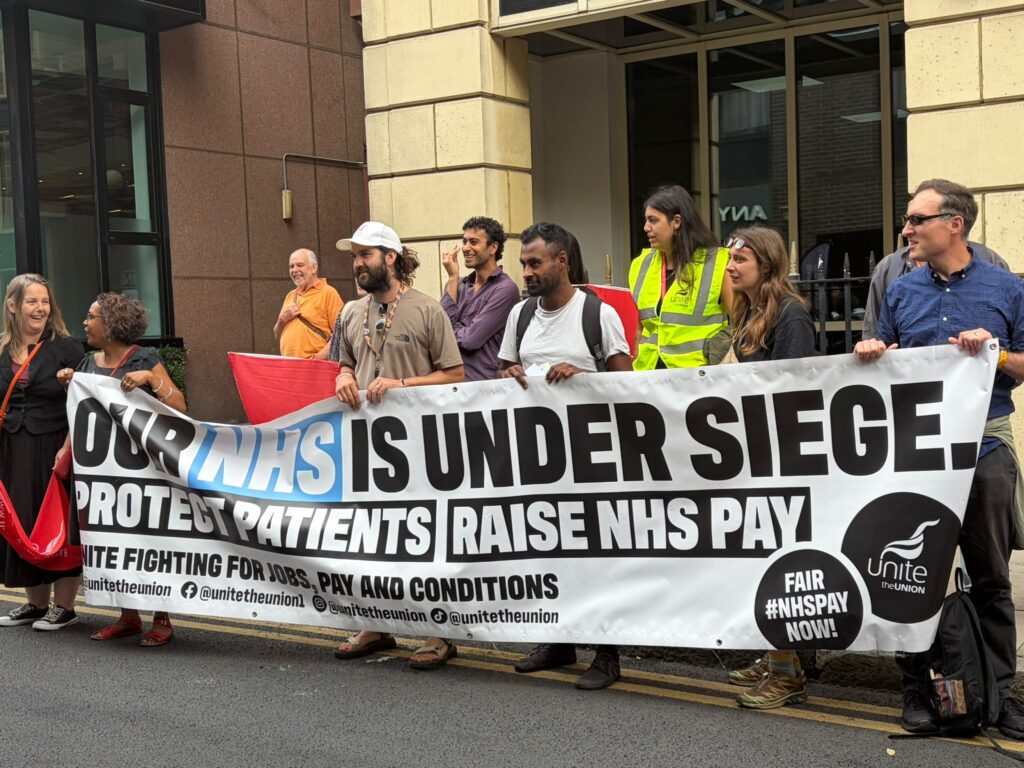
Workers in Unite at East London Foundation Trust protest against planned job cuts (pic: Keep Our NHS Public)
What NHS jobs are at risk?
These cuts will reach far beyond administrative restructuring and threaten staff across acute hospitals, mental health and community health services, public health and the organisations responsible for planning and supporting NHS services.
This includes doctors, nurses, allied health professionals, healthcare assistants, mental health workers, administrative staff, technicians, managers and essential support workers.
Some posts are disappearing through redundancy. Others will be abolished when staff leave, left permanently vacant through recruitment freezes and reductions in bank and agency staffing, or deleted permanently. These distinctions matter, but result in the same damaging consequences.
An unfilled nursing post still represents nursing care that cannot be delivered. Remaining staff have to work harder, with risk to themselves from stress, burnout and moral injury as well as to their patients. The loss of experienced administrative and support staff places additional pressures on frontline clinicians often eroding the time available for direct patient care. Cutting temporary staffing without providing sufficient permanent replacements can leave already overstretched services struggling to function. Recently chemotherapy treatment for patients was delayed because of cuts to bank staff rates.
The NHS cannot recover by systematically reducing the workforce on which its recovery depends.
What will the consequences be?
The NHS is already struggling to meet basic standards of patient care. By September 2026, there were 7.38 million cases awaiting treatment in England, representing 6.24 million individual patients. In October 57,000 patients waited over twelve hours for a hospital bed after a decision to admit them and thousands of patients are receiving care in corridors every day –currently 3,300 daily.
The Royal College of Emergency Medicine has estimated that delays in emergency care are associated with over 300 excess deaths every week (16,000 each year). These are the consequences of a system already operating under intolerable pressure. Further large-scale workforce reductions threaten longer waits, worsening access to treatment, increased workloads, deteriorating staff morale and greater risks to patient safety.
But the damage will extend beyond hospitals. NHS workers and their families face the prospect of lost income, unemployment, insecurity and financial hardship. Communities could lose skilled jobs and substantial local spending power, damaging their local economy. Nearly 3 million are out of the workplace for health reasons. Staff shortages and worsening health outcomes increases economic inactivity and places further pressures on public finances in a downward spiral. Cutting NHS jobs to save money risks producing enormous additional costs, both human and economic.
Are 100,000 NHS job cuts inevitable?
No. But without a decisive change of policy, tens of thousands of job cuts are an unwinding consequence of the Government’s current approach.
As set out, our analysis suggests that even the least severe scenario could see 65,000 NHS posts lost by 2028. If workforce reductions across trusts average around 6%, the figure reaches 100,000. If pressures intensify further, the outcome could be substantially worse.
None of these outcomes is unavoidable. The scale of the cuts will depend on decisions made by Government and NHS leaders, and the response from trade unions and those prepared to campaign for a properly funded health service.
It is essential that local issues are joined up so that there is a coordinated national response. The trade unions have a crucial role to play here. We need to recognise the threat in its entirety, before it is too late.
What must be done? A national crisis demands a national response
Keep Our NHS Public calls for an immediate change of policy direction from the Government.
The Government must halt damaging workforce reductions, abandon unrealistic financial targets and provide the investment necessary to protect services, rebuild staffing and meet the needs of patients.
That requires halting the implementation of Streeting’s failing 10-Year Health Plan, reconsidering the financial framework and breaking with the fiscal rules that prevent the NHS receiving the resources it needs.
But government action will not happen without sustained public and political pressure.
We urgently need a coordinated national response from NHS trade unions, health campaigners, patients, community organisations and progressive politicians.
Trade unions have already fought hard to protect jobs and services in individual trusts. Those struggles must be supported and brought together into a national campaign capable of confronting the overall scale of the threat.
We call on everyone campaigning for the NHS, public services, trade union rights and investment in welfare rather than warfare to recognise what is at stake.
We call on MPs and political representatives across Parliament who believe in a publicly funded, publicly provided NHS to demand urgent government intervention.
And we say directly to Prime Minister Andy Burnham: you cannot promise to end 40 years of neoliberalism while allowing austerity-driven cuts to devastate our National Health Service.
- We cannot rebuild the NHS by cutting the people who keep it running.
- We cannot shorten waiting lists by reducing the staff needed to treat patients.
- And we cannot protect public health by forcing already overstretched services to shrink still further.
100,000 NHS job cuts are not inevitable. But preventing them requires political choices, national organisation and collective action now.
The future of the NHS is at stake. We must act together before it is too late.
Leave a Reply