
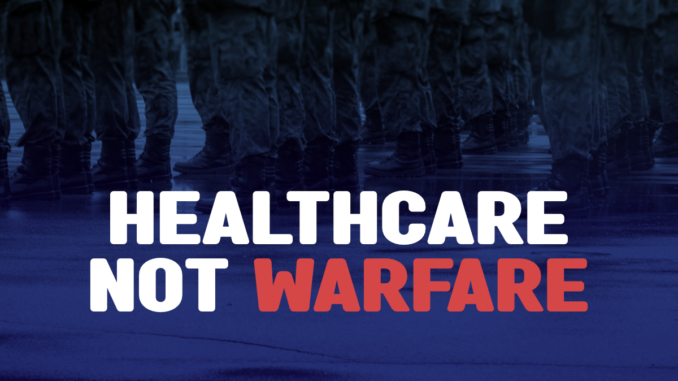
Britain’s military is one of the best-funded in the world. In contrast, our NHS – once the best healthcare service in the world – has been steadily undermined over the last 15 years to the point of near-collapse. Lucy Nichols examines
Anyone can see that the NHS is in need of drastic intervention: a funding injection, better pay and conditions for staff, an end to the private companies leeching off the health service, and a commitment from the Government that the NHS and social care is a priority.
Under Keir Starmer and Wes Streeting, one of whom has left the Cabinet and the other on his way out, the NHS has not fared much better than it did under the Conservatives. Wes Streeting’s tenure is marked by privatisation, chaos and failure. His successor, James Murray, is yet to introduce any improvements, and committed to continuing Streeting’s terrible policy record.
Unfortunately, in his last weeks as Prime Minister, Keir Starmer has not decided on a funding boost for the NHS, or indeed any public service. He has instead given a huge injection of money – £15 billion – to defence. This will leave Andy Burnham (likely our next Prime Minister) forced to cut public spending elsewhere to find the extra £4.7bn to pay for the military. This £15bn is just a small part of the nearly £300bn that the Government has committed to spending on defence over the next four years, including billions to go towards nuclear submarines and warheads. The justification is that Britain is under immense and serious threat, and that we must strengthen our military to keep people safe from outside bad actors.
However, it is hard to square this huge increase in defence spending with reality. Columnist Simon Jenkins argued in the Guardian that the defence spending boost is built on very little substance:
‘There is no evidence that Russia has evil designs on British territory that require a massive deterrent force. That one nation may have the capacity to “threaten” another far from its borders is not evidence that it intends to do so.’
This boost in defence spending does, however, reflect the growing drive to war across the UK and Europe. In the UK, the Government has already tried to introduce a military gap year, and – in London at least – it is hard to miss the military recruitment adverts clearly aimed at young people.

Across Europe, conscription seems to be making a comeback, with Germany introducing a law forcing young men to notify the Government if they leave the country for any period of time. Nato has introduced military spending targets for its member nations, and by 2035 Britain could be expected to spend 3.5% of GDP on the military – much more than the already high 2.4% we currently spend. Britain already spends more on its military than almost everywhere in the world, and is behind only the US, China, Russia, Poland and Germany.
Even more worrying is that Starmer’s latest military spending boost is to come at the cost of public spending, with cuts to roadways and energy projects expected to help fund it – to the outrage of MPs in the affected constituencies. While there is no indication that anyone wants to cut NHS budgets to fund the military, the Government is making its political commitment very clear when it cuts public spending to favour defence. This direction of travel says everything about the Government’s priorities and should be of serious concern to those of us campaigning for a public health service which urgently needs greater investment.
With three million out of work for health reasons, failure to invest in the NHS undermines population health and the economy. Furthermore, these cuts to public spending will put 100,000 jobs at risk, and few new jobs will be created in defence. The Guardian interviewed researcher Khem Rogaly, who said:
“Far more jobs are created when investing in public needs like health, education and addressing the climate crisis. This latest data suggests that the turn towards autonomous weapons and AI could also mean that military spending creates even fewer jobs per pound than before.”
What we are seeing here is not, as the Government may have you believe, a genuine attempt to keep Britain safe, but an ideological choice that puts the military before public spending.
If Starmer were truly concerned with protecting the lives of Britons, he would turn instead to the NHS, where thousands are dying avoidably each year, where waiting lists are deadly, and where there simply isn’t the infrastructure to keep up with need. He could spend £15bn instead, for instance, on social care, where private companies scramble for profit and often leave those who need care without. He could spend it on disability benefits, instead of making the cuts to PIP that will leave many thousands of disabled people with far worse qualities of life.
Keep Our NHS Public is a campaign that focuses on the NHS and social care: we want to see a public health service that meets the needs of the population, free at the point of need and publicly funded, provided and accountable. Increasingly, we have been turning our attention to the Government’s drive to war and foreign policy decisions because these are closely linked to the NHS in a number of ways.
The latest defence spending plan makes this more clear. As NHS activists, we must absolutely be concerned about foreign policy and military decisions that come at the expense of public spending.
Leave a Reply