
Reviewed by John Puntis, Co Chair Keep Our NHS Public
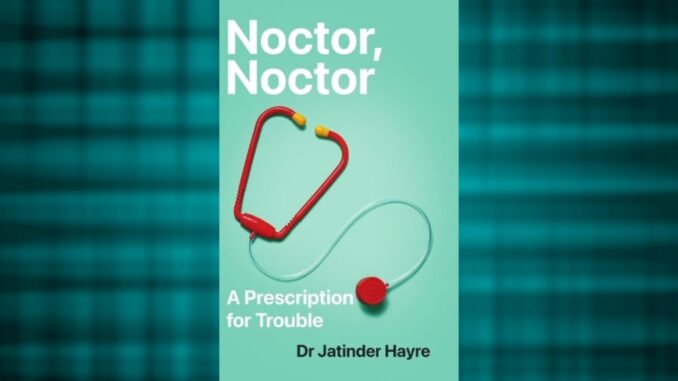
Jatinder Hayre. ‘Noctor, Noctor. A prescription for trouble’.
Icon Books Ltd., London 2026. Publication date 24/09/2026
‘Noctor’ is slang derived from blending the words ‘not a doctor’ and this book is the story of ‘Noctoring’ – the systematic replacement of doctors with the ‘not a doctor’. ‘Noctor’ refers mainly to physician associates (PA), the largest group of Medical Associate Professionals (MAP), which also includes Anaesthesia Associates (AA), Surgical Care Practitioners (SCP) and senior nurse Advanced Practitioners (AP). The book is a heartfelt plea for a fundamental change of direction prompted by seeing at first hand the negative impact of doctor substitution on both staff and patients while concerns expressed to those in senior positions were brushed aside. Lack of supervision of doctor substitutes results in harm that is difficult to quantify but includes over-investigation, its consequences for patients and the attendant costs.
Deprived areas struggle to recruit doctors and rely more on MAPs so that in terms of quality of care, patients here become even more disadvantaged. The fact that harms cannot easily be identified has led to complacency rather than rigorous evaluation of the impact of MAPs. This is despite a rapid review of the available scientific literature concluding that the absence of evidence of safety incidents should not be misinterpreted as evidence that deployment of PAs and AAs is safe. New research is urgently needed to explore staff concerns, examine safety incidents, and inform a national scope of practice for these relatively new and contested staff roles.
Some important context is missing from the book. PAs were introduced to the NHS in 2003. As numbers grew, so did concern about them being used (despite very limited training) as doctor substitutes, threats posed to patient safety, and the potential for patients to be misled into thinking they were actually seeing a doctor. The enthusiastic support for MAPs from leaders of Royal Colleges led to a member backlash by both physicians and anaesthetists. Among others, the President of the Royal College of Physicians was forced to resign after a member survey was misrepresented as showing support for PAs. The British Medical Association demanded clear rules for what PAs should and should not be allowed to do, and objected to the doctors’ regulator, the General Medical Council, agreeing to take on the regulation of MAPs, arguing that this added further to confusion over professional roles.
The 2023 NHS workforce plan anticipated a tripling of PA numbers to around 10,000 by 2036/7 together with 2,000 AAs. Outcry from the medical profession prompted the Leng Review to examine the role of PAs and AAs, commissioned by the Secretary of State for Health. Recommendations aimed to make distinctions between PAs and doctors more visible while also stipulating the need for senior clinical supervision. From Hayre’s personal experience, however, it would seem that little has changed on the ground and concerns about PAs being encouraged to work beyond their competence remain. Not only that, it is widely reported that gaps in doctors rotas are now being covered by Advanced Practitioners.
As Hayre points out, the ‘noctor’ model is served by reducing medicine to a series of tasks and checklists and justified by talk of ‘skill mix’, ‘flexibility’ and ‘task-shifting’ as if these are all uncontested signifiers of progress. One chapter is devoted to ‘McDonaldisation’ of medicine – reshaping care in the quest for greater efficiency and prioritising models that resemble industrial service delivery: ‘The aim is not to know the patient, but to process the presentation. Care becomes something that can be completed.’ Such systems organised around throughput favour workers like MAPs that can be trained quickly, deployed flexibly and are governed by protocol. However, as noted, little valid research has been done on the consequences of this approach and while doctor unemployment is a significant issue, jobs for PAs continue to be advertised. Rather than alleviating pressure on doctors, MAPs (like resident doctors) still require supervision, training and where necessary, correction.
Hayre identifies the rise of managerialism following the 1983 Griffiths report with the curtailing of professional freedoms as the NHS moved into the era of the financialisation of health care. This has been referred to by others as the proletarianisation of medicine whereby physicians are subordinated to the broader requirements of the capitalist control of profitable medical production. Over recent years, MAPs have come to fill gaps left by underinvestment in training and attrition in the workforce from low morale.
Perhaps too much is made in the book of the NHS being conceived as a public embodiment of compassion, and as a civic covenant – no less than a moral agreement between the state and its people. In fact, the government’s justification for investment in the creation of the NHS rested on interlocking economic grounds rather than purely moral ones. Bevan linked healthcare to the national economic renewal of the state, arguing that treating illness early would keep people working and contributing. Investing in healthcare was seen as investing in economic output. The government proposed that a universal system would catch illness earlier, reduce expensive emergency care, and lower overall societal costs over time. Centralised funding meant lower per-person administrative costs, more predictable public spending, and elimination of profit extraction in core services.
Before the NHS, illness often meant loss of income, medical bills, poverty or debt. This was economically destabilising, reducing consumer spending and increasing reliance on poor relief. By making healthcare free at the point of use, the NHS stabilised household finances and helped maintain demand in the wider economy. The Beveridge report also argued that tackling ‘want, disease, ignorance, squalor, and idleness’ would reduce long-term public expenditure and create a more efficient, stable society. Upfront public investment reduces future social and economic costs. Healthcare is not just a cost—it is a productive investment that reduces inefficiency, supports growth, and stabilises the economy. This of course is highly relevant to the current contradictory government position that subordinates finding the funding needed for rebuilding the NHS to growing the economy. Meanwhile, there are 2.8 million people out of the workforce because of ill health. The argument that an efficient NHS is essential for building a strong economy remains valid.
Hayre concludes by summarising what might be done. If doctors are defined by capacity to navigate uncertainty, this comes from their extensive training and cannot apply to much less well-trained MAPs. Job titles should be transparent as should the scope of practice including explicit boundaries. There must be a national regulatory framework (covering training, assessment, supervision, definition of work roles). Supervision should be formal, structured and transparent while there must be investment in medical training to increase the numbers of doctors. Although Hayre does not make this suggestion, this could include career progression for some MAPs who wish to re-train as doctors. Adequately addressing patient safety issues through implementation of the above framework would ensure that MAPs can play an important role within the multi-disciplinary team.
Buy or borrow this book and read it carefully. It should help to reinvigorate the debate about medical professionalism, clinical freedom to do what is best, workforce needs, quality of care, the key importance of personal interaction between doctor and patient, and whether the NHS now needs to be refocussed on safety and the needs of patients. This is more important than ever given the techno-optimism of the Ten Year Health Plan for England and its unevidenced assumptions around the transformative nature of technology and Artificial Intelligence. Such notions link to increasing emphasis on digital interaction with health care services (effectively disenfranchising many), the erosion of the importance of continuity of care, and most likely also to the apparent government indifference to the increasing number of job losses.
In this context, further weakening of professional roles in favour of less well trained, cheaper and more compliant alternatives seems to be the desired trajectory. An updated workforce plan is imminent, but a lower number of staff than in the 2023 plan is already a stated aim. This trend will only be reversed when neoliberal policies are abandoned and the NHS can be fully restored as a publicly funded, provided and accountable service. To quote Hayre, ‘The question is not whether the NHS can function with fewer doctors…but whether it should.’
John Puntis
Co-chair Keep Our NHS Public
Good last line quote – of course it shouldn’t. Person to person contact is much more likely to come up with a correct diagnosis than machinery, and automated systems may well end up keeping people in hospital longer than necessary – or delaying admissions in a way which exacerbates the situation and not only increases patient suffering but ultimately costs more to treat it. Given the current pressures, it is not surprising that fewer people are training as doctors – we really need to do something about this. I was born in the year the NHS was founded and have relied on it all my life – let’s try to preserve it so future generations can do so as well.
A briiliant,concise yet all encompassing critique of all that is wrong in the NHS, focussed on the importance of the use of ‘noctors.’ Thank you John and Jatinder