
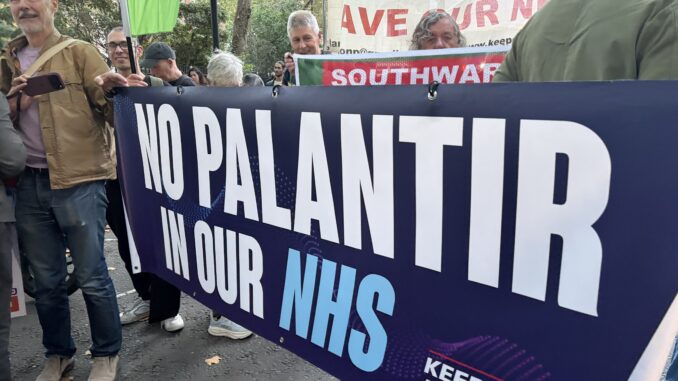
We need to keep pushing to get Palantir’s Federated Data Platform out of our NHS. Keep Our NHS Public Co-Chair, John Puntis, explains why
Palantir Technologies is a company founded in 2003 by US billionaire Peter Thiel. Palantir’s software programs can process vast amounts of data to identify previously undetectable patterns and connections. The founding premise was that governments and public agencies hold a lot of information, but it is difficult to access and poorly organised. If properly collated and arranged, the data could be employed to enormously powerful effect. Foundry and Gotham are its leading software. The company name comes from the ‘palantiri’ – all-seeing magical orbs in Tolkien’s ‘Lord of the Rings’ (LOTR) trilogy. In the same vein, employees are sometimes referred to as ‘hobbits’ and their mission as being ‘protection of the Shire’. Such appropriation of playful words, rather than being reassuring, helps paint an increasingly clear picture of members of a repugnant neo-reactionary movement. Their early views have been shaped by science fiction and comic books giving them a “disdain for not just governance, but the very systems of life itself, that which sustains life.”
Peter Thiel – billionaire ‘libertarian’ Trump fan
Thiel is a co-founder of PayPal, a Facebook investor, venture capitalist and a Trump supporter who has given generously to Republican candidates in the US elections. He has recently hosted a series of lectures philosophising about who the antichrist (a false saviour substituting for Christ before his second coming) could be (he suggests Greta Thunberg among others!) and warning that Armageddon – the final battle between good and evil at the end of the world – was coming. The Epstein files show that he remained in contact with the financier for years after Epstein’s 2008 conviction for soliciting prostitution from a minor. Thiel is on record as saying that the NHS makes people sick, and that the public’s affection for it is a case of Stockholm syndrome – the term for hostages developing empathy with their captors. He has argued that rather than receiving more funding, the NHS should be ripped up and subjected to market mechanisms. Palantir was a client of Global Counsel, the political lobbying and advisory firm co-founded by Peter Mandelson.
Thiel is said to have become fixated on Islamic terrorism and developed hardened views on immigration, creating Palantir as a tool to combat terrorism by processing and spotting patterns or connections in massive tranches of data. He had previously overseen the development of software to spot fraudulent activity in PayPal transactions. Early funders of Palantir included In-Q-Tel, the venture capital arm of the Central Intelligence Agency, the US foreign intelligence service. A self-declared ‘libertarian’ (he declares that he stands for “authentic human freedom and against confiscatory taxes and totalitarian collectives”), Thiel stated in 2009 that “freedom and democracy” are not “compatible.” The political commentator Chris Hedges describing the current situation in the United States says that “Thiel is sweeping up all our information gleaned from government tax, medical and law enforcement records. This information is being delivered to databases that can be exploited for state control and profit. Thiel and his coterie of technocratic billionaires are implementing the agenda he envisioned 16 years ago: to make technology an alternative to politics.” Reading this, it is easy to imagine that this might be the reason why Palantir has been welcomed by the increasingly authoritarian British state.
Palantir’s business
Palantir serves two broad types of clients including big businesses such as British Petroleum, Airbus and Coca-Cola, together with civil government sectors, such as America’s Inland Revenue Service and the UK’s NHS. The second type of client is military, defence and intelligence services. While Thiel remains chairman of Palantir and a major shareholder, Alex Karp (also a co-counder) is the chief executive. Karp openly acknowledges that Palantir’s technology can be part of military operations in which people are killed. He characterises Palantir is being dedicated to serving the West and the United States, and there to “scare our enemies and on occasion kill them.” A military mindset has pervaded the internal culture at Palantir since its inception.
Palantir’s business model is widely described as ‘land and expand’ with targeting of government and large commercial organisations with low-cost pilots, low barrier entry trials or short term engagements to demonstrate value. Palantir ‘landed’ in the NHS during Covid in 2020 with an initial short-term contract for the NHS Covid-19 Data Store, at a cost of £1. This contract was to help manage Covid-19 data and help shape the government response. Initially short term, it was given a number of extensions, with Palantir thereafter being granted the contract for an NHS Federated Data Platform (FDP). The FDP is designed to allow hospital trusts, local systems, and national coordinators to look at real-time information in one place without logging into multiple networks with the aim of increasing NHS efficiency and productivity. As far as ‘expanding’, the company now has contracts with multiple UK government bodies with at least 34 current and past state contracts across at least 10 government departments (including the NHS), local councils, and police authorities.
While NHS England claims that “the platform was procured via a rigorous, competitive procurement process in line with government procurement legislation”, the contract was only published after considerable pressure from campaigners and then with 200 pages blacked out. In order to win the contract, Palantir has been accused of widespread lobbying of government ministers and civil servants as well as operating a ‘revolving door’ for a number of key NHS executives, civil servants and politicians. The latest high-level recruit is Lord Tom Watson, former deputy leader of the Labour Party. After his blustering defence of Palantir’s FDP contract on morning radio, the chair of the Commons Select Committee on Science and Technology neatly dismissed him, stating he could not be more wrong on Palantir and was not the first politician she had seen blinded by tech hype. Watson went on to give dire warnings against the dangers of ‘the mob’ being left to determine how government contracts were awarded. This rather suggests his views on democracy align very much with the company who now pay him.
The campaign to get Palantir out of the NHS
Campaigners against Palantir have many objections to its involvement in the NHS including its unethical behaviour through complicity in multiple human rights violations, such as the genocide in Gaza, mass deportation and detentions by US Immigration and Customs Enforcement Agency (ICE), military interventions in Iraq and Afghanistan, and discriminatory policing practices. Contracts with ICE have included designing a system to track undocumented migrants and select candidates for deportation. The company signed a $10 billion deal with the US Army and a recent contract included a $795 million uplift to help the Pentagon develop an AI-targeting system called Maven. In early 2024, Palantir signed a deal with the Israeli government to provide “support for war-related missions”. The company is explicitly mentioned by the UN special rapporteur on human rights in the occupied Palestinian territories. Her report urges member states to enact sanctions, pursue criminal investigations of corporate executives, and enforce an arms embargo. Palantir’s Maven Smart System was involved in the targeting chain that led to the destruction of the Shajareh Tayyebeh Elementary School in Minab, Iran, on February 28, 2026, killing around 180 people, mostly girls aged between 7 and 12.

A wide range of organisations including Keep Our NHS Public (KONP), Medact, The Good Law Project, Amnesty International, Doctors Association UK, Just Treatment, Foxglove, Liberty, medConfidential, Global Justice Now, the British Medical Association and War on Want oppose Palantir being involved in the NHS. A coalition of activists has been organised under the banner ‘No Palantir in our NHS’ with local groups across England. A briefing in March 2026 from Medact urged NHS trusts and ICBs not to implement the FDP and for NHS England to terminate the contract. Over August 2026, KONP held twice weekly anti-Palantir demonstrations outside the Department of Health in London. The Medact report notes that partnering with Palantir risks weakening patients’ trust while “driving out locally tailored and trusted data solutions”. Thursday October 1st saw an international day of action against Palantir with over 40 protests outside hospitals and elsewhere in the UK. The following day, the Times newspaper reported that government was actively investigating UK companies as an alternative to Palantir.
Confidentiality of patient data
For those concerned about who has access to their private data, Palantir insists that it is only a processor of patient data, not a controller, and has never been in the business of collecting, mining or selling data. In reality, NHS England has allowed staff from the US tech firm and other contractors to access patient data before it has been pseudonymised, despite internal fears being expressed around a “risk of loss of public confidence”. Futhermore, US legislation like the Cloud Act, the USA Patriot Act and the FISA (Foreign Intelligence Surveillance Act) allows the US government to compel US-headquartered companies to hand over data, regardless of where that data is physically stored or what local contracts say. Any reassurances from the UK government should also be seen in the context of its current policy to harness the power of data to drive economic growth including a reduction in data protections and an increase in access to our personal health data by private corporations. It is not possible for patients to opt out of their data being processed by the FDP.
Is the FDP really benefitting the NHS?
Many of those working in NHS IT have expressed scepticism about the benefits of the FDP, with some local NHS trusts and bodies refusing to comply with the roll-out. Specific examples are Leeds Teaching Hospitals NHS Trust which told NHS England that it would lose functionality rather than gain it if it adopted the FDP and NHS Greater Manchester saying its local capability exceeds anything the FDP currently offers. Government claims that the FDP is delivering benefits have been undermined through an investigation by Foxglove which found that almost a third of English hospital trusts using the FDP tool were carrying out fewer operations than before they started using it.
An early adopter of the FDP, Chelsea and Westminster Foundation Trust, was regarded as “a national exemplar for AI”. An apparently successful pilot of a precursor of the FDP developed by Palantir was promoted to persuade other hospitals to sign up. Problems were then highlighted in the British Medical Journal, casting doubt on positive outcomes. While it was claimed that the inpatient elective surgery waiting list had been brought down by 28%, in fact, improvements were most likely due to post-pandemic recovery with data showing no meaningful difference between FDP adopters and non-adopters. There was no evidence of a unique impact of the FDP at Chelsea and Westminster. It also happened that Matthew Swindells, the trust’s chair from April 2022 to March 2026, not only previously worked with Palantir through Peter Mandelson’s firm Global Counsel but also chaired the company’s health advisory committee – a clear conflict of interest. Swindells was forced to resign after the Financial Times revealed he had privately urged colleagues to add GP patient data to the FDP in a bid to demonstrate its effectiveness.
Up until May 2026, NHS England’s website was trumpeting how the FDP was delivering more procedures, shorter stays in hospital, improvements in cancer diagnosis, and reductions in referral time. Since then it has added a note explaining that its before/after comparisons showing improvements following the introduction of the FDP simply cannot generate firm conclusions about cause and effect since other variables were not controlled for. In other words, there is no certainty about Palantir having delivered improvements in NHS performance. This, however, has not stopped the indefatigable Lord Watson from repeating such unsubstantiated claims. The UK Statistics Authority is currently investigating the Department of Health and NHS England over misuse of statistics to promote the FDP. In the meantime, the NHS is running an analysis of the commercial deal with Palantir, which is due to report this autumn. It has also commissioned a three-year independent evaluation by Imperial College, with findings expected in 2029.
The end of the contract
MPs debated the FDP on 16th April 2026, with several Labour and Liberal Democrat MPs urging the government to remove Palantir as the contract supplier. In response, the health minister Zubir Ahmed said that while the government was “no fan” of Palantir’s politics, the FDP had been exceeding its performance targets since it went live in March 2024. Asked whether the government would exercise the ‘break clause’ in Palantir’s contract in 2027, Ahmed said, “If at that point in the break clause we evaluate and we find that there are other providers that can do the job better, of course then that needs to be looked at. We will decide later this year whether to extend it.” The FDP contract was due to run for an initial three-year term, followed by three possible extension periods. The first term finishes at the end of March 2027, and for it to continue beyond that point, the Department of Health and Social Care must actively choose to trigger the first extension. If it does not, the contract will in fact come to an end. The deadline for any such renewal is 31st December 2026. An exit process has to be agreed before then and will begin implementation after 31st December if there is no renewal.
In a June 2026 report, the House of Commons Science, Innovation and Technology Committee concluded that Palantir’s growing role in the NHS and wider public sector was creating an “unacceptable point of weakness” for the UK. The Committee recommended breaking the contract for the FDP and either developing an in-house replacement or transitioning to an alternative UK-based supplier. In addition, it also commented that reliance on major US-based tech firms like Palantir leaves public service digital transformation at risk and “at the mercy” of foreign actors. The report called for a clear strategy to diversify suppliers, enhance digital resilience, and achieve technological sovereignty. The Health and Social Care Committee also recommended that government drop the contract with Palantir, citing serious mistrust among the public, unproven efficacy and the existence of alternatives already in place across NHS bodies. Of course, cutting links with Palantir will not signal the end of our unhealthy dependency on big US corporations, but rather, should be the first sweep of the broom aimed at establishing UK digital sovereignty.
On the international stage, opposition to Palantir is becoming more visible. New York City’s public hospital system, the Dutch Ministry of Defence, the French intelligence service and the Danish government have all either not renewed Palantir contracts or are actively looking for new suppliers. Switzerland’s army raised concerns that confidential military data could be passed on to US intelligence agencies if defence contracts were awarded to Palantir.
In the UK, arguments for ending Palantir’s contract for the FDP include concerns around patient-data privacy and trust with a US technology company being embedded in NHS data infrastructure; Palantir’s work with US government agencies, particularly immigration enforcement and military/intelligence bodies; human-rights concerns, given Palantir’s involvement in the genocide in Gaza; worry that the NHS could become dependent on a US supplier; procurement and transparency and how the £330m contract was awarded in the first place; access by Palantir personnel to NHS systems; effectiveness and value for money. As the ‘No Palantir’ coalition has summarised: “Palantir is a secretive US data company that wants a long-term role deeply embedded in NHS infrastructure. However, it has spent most of its history helping the powerful abuse the powerless. For years, Palantir’s tools have been used not to care – but to harm.” For all the above reasons, a company like Palantir has no place in our healthcare system. We cannot afford to slacken the campaign to achieve a Palantir-free NHS until we have won.

Scary! I was aware that Palantir had largely commercial interests, but not quite of how big an influence it had. We really need to kick it out of our NHS if we want to save the NHS founding principles – free treatment for all and no private profiteers. I think there is still time to save it and still enough support for. its founding principles, but we need to act fast.
Scary! I was aware that Palantir had largely commercial interests, but not quite of how big an influence it had. We really need to kick it out of our NHS if we want to save the NHS founding principles – free treatment for all and no private profiteers. I think there is still time to save it and still enough support for. its founding principles, but we need to act fast.