
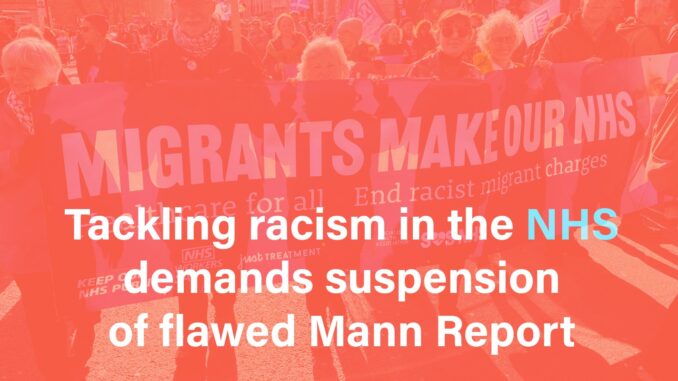
The Lord Mann review of ‘antisemitism and other forms of racism in the NHS and healthcare regulatory system’ presented a series of recommendations aimed at tackling racism in the NHS. KONP agrees that antisemitism and other forms of racism are both abhorrent and unacceptable. However, the report’s one-sided focus on a particular form of racism (antisemitism) demonstrates that it is inadequate for the task it was set. KONP does not accept that there is a hierarchy of racisms and agrees with comments on the report from the British Islamic Medical Association, the Muslim Doctors Association, and numerous other bodies: ‘While its focus on antisemitism is important, it does not adequately reflect the broader and escalating reality of racism across the NHS’. Concern was not only about tackling racism, but with ensuring that anti-racism policy ‘is lawful, evidence led, proportionate, and applied fairly across all communities’.
The Mann Review should now be set aside pending a broader government investigation into racism in the NHS, which must include the involvement of racially minoritized groups who are bearing the brunt of racist attacks and prejudices.
The best man for the job?
Mann was appointed to the paid post of government advisor on antisemitism by prime minister Theresa May in 2019. He had been MP for Bassetlaw since 2001 but declined to stand for parliament once again and was made a life peer in May’s resignation honours list. The Times newspaper reported that the list was held up by a row over Mann’s inclusion, with the independent watchdog on Lords appointments warning it could be seen as a bribe for his support of her Brexit withdrawal bill.
Mann had been a vocal critic of what he regarded as Jeremy Corbyn’s flawed approach to handling anti-Jewish hatred. He is also remembered for a filmed confrontation with Ken Livingstone, calling him a ‘Nazi apologist’ and a ‘fucking disgrace’. Together with Penny Mordaunt, Mann co-chaired a ’Commission on Antisemitism’ instigated by the Board of Deputies of British Jews. This considered antisemitism within the NHS to be a particular problem. He has been quoted as saying that he regards antisemitism as ‘the worst of racisms’ but has also been criticised for being reluctant to call out antisemitism among Conservative politicians. Mann considers that ‘the levels of anti-Jewish racism in the UK constitute a national emergency’.
The Mann review recommendations
Many of the recommendations are uncontroversial in themselves, relating to improved training and monitoring with respect to racism. Recommendation 1 is that the Department of Health and Social Care and the NHS should adopt the Seven NHS Race and Health Observatory workforce principles and encourage wider NHS organisations to do so. These are indeed a good framework for fighting racism, but Mann appears not to have followed them in conducting his own review. For example, he has failed on principle 3 which states: ‘Creating an anti-racist healthcare system requires the meaningful and sustained inclusion of racially minoritised communities from the outset. Too often, their involvement is tokenistic, transactional, or comes too late to effect real change. True inclusion means actively partnering with those typically excluded from healthcare decisions, ensuring their voices shape priorities, design, and implementation’. Principle 5 also warns against racial bias, saying that: ‘biases can be deeply embedded…even where individuals are working to tackle racism’.
Recommendation 8 is controversial and states: ‘Some political identifiers can and do cause distress to patients, and employers should develop local policies to be clear about what is acceptable. In order to create an inclusive NHS, upholding the aim of everyone feeling safe to seek and receive care, NHS England should update national uniform guidance, in line with reviewing broader guidelines for those in the NHS using its name, logo or branding, including in relation to social media accounts.’ Lord Mann does not have an issue with staff wearing religious symbols such as a crucifix or the Star of David although this is problematic for some.
While a complex area, reading the report for some will reinforce the perspective that the remit of the Mann review included suppressing pro-Palestinian expressions of solidarity among health care workers. Prior to publication, twenty-three organisations including Jewish Voice for Liberation felt that the Mann review would weaponise antisemitism to silence doctors on Gaza. For those who see the ongoing crushing of opposition to the British state’s complicity in Israeli atrocities, this would not require any great leap of faith. Many healthcare staff not only deplore the loss of civilian life in what they and others regard as a genocide, but note that health workers and facilities in Gaza, the West Bank and now Lebanon have been deliberately targeted by the Israeli army.
It is clear of course from the large number of Jewish people who join Palestinian solidarity marches up and down the country that a pro-Palestine stance does not constitute antisemitism. It is worth noting this statement by Mann: ‘To be clear, freedom of expression, which is legally protected by the Human Rights Act (1998) allows people to say things that others find offensive. Attacking the actions or policies of the Israeli government or state, including in ways that some will see as offensive, or support for a Palestinian state or the plight of Palestinians, does not in of itself constitute antisemitism or contradict IHRA’ (the International Holocaust Remembrance Alliance).
There is legitimate debate about wearing badges in the workplace. We would not, for example, wish to see political badges supporting far right populist parties or anti-abortion campaigns. Clinicians should already follow GMC guidance on good medical practice which states the requirement to ‘respect every patient’s dignity and treat them as an individual’; to ‘protect and promote the health of patients and the public’; ‘never unfairly discriminate against patients or colleagues’. For many, taking overtly political signs into the consulting room would be rejected as potentially counterproductive and a potential barrier to establishing a good relationship with some patients who might not share the same views.
One of the difficulties here is defining Lord Mann’s ‘political identifiers’. Would such things as the flying of the Israeli flag from the Department of Health, or hospitals lighting up in the colours of Ukraine be included? Would the rainbow lanyard for showing support to the LGBQTQ community be allowed? What about trade union or professional symbols or international flags? The question of who decides what is ‘political’ is deeply concerning. Mann has delegated this to NHS bodies to decide while national uniform guidance will be updated by NHS England.
Criticism of Mann report by the British Medical Association (BMA)
The BMA confirmed the need to combat antisemitism and racism that patients and doctors face in the NHS, stating that the service must be inclusive and patients should not fear disclosing their religious identity. It supported the review’s recommendations for improved training, monitoring, and shared principles. On the wearing of political symbols it said: ‘Many symbols that could be deemed “political”…demonstrate to patients and colleagues that we are safe, have shared languages, shared values, or are prepared to celebrate our diverse staff and patient populations. A blanket ban on all symbols that could be construed to express a belief would go too far’.
It went on to say: ‘…who gets to decide what counts as political[?]. The review recommends both updated NHS national guidance on uniform and that employers develop local policies about what is acceptable, but gives no recommendation on what happens if these don’t align. We are concerned that employers will take differing views about what is acceptable, leaving doctors and other healthcare staff without the clarity they need. Any new guidance must be consistent across the country, be aligned to NHS national guidance, and must clearly distinguish legitimate expression from misconduct… We would welcome the opportunity to engage with the NHS on developing such an approach as they update their guidelines following this review’. Recent BMA motions passed by conference included calls for an immediate pause in the implementation of the Lord Mann Review, and opposition to the implementation of recommendations that would restrict lawful expression beyond existing legal and professional standards.
The BMA are also worried about possible changes to the powers of the General Medical Council (GMC) – the regulatory body for doctors, and are initiating legal action over this. When the GMC investigates a doctor, it is its own Medical Practitioners Tribunal Service (MPTS) that hears the case and decides whether the doctor is fit to practise and what, if any, sanction they should face. Recently, a decision by the MPTS exonerating a doctor of alleged antisemitism and support for terrorism was then challenged by the GMC, forcing the doctor to defend himself once again. The BMA believes the process by which the GMC is able to appeal against the findings of its own tribunal undermines doctors’ trust in the regulator. This position was backed by the Williams Review in 2018, which recommended removal of the GMC’s right to appeal, and with which successive governments have agreed. This was also the unequivocal recommendation of the independent Hamilton review in 2019 that was commissioned by the GMC itself.
Despite the above, the Government consultation on reforming the GMC proposed not only retaining the GMC’s right to appeal MPTS findings, but also expanding that right to interim decisions. The Government consultation (launched in March) claimed this proposal was based on a recommendation that would appear in the yet to be published Mann Review. When this Review was actually published on 4th June, Mann’s recommendation was that “the government should consult on the following proposal: PSA and GMC should have a right of appeal against a fitness to practise panel’s interim…decision.” This therefore appears to have been be a rather circuitous process. The PSA is the Professional Standards Authority for Health and Social Care, an independent body accountable directly to Parliament, that oversees 10 statutory bodies regulating health professionals across the UK and social care workers in England.
What do targets of ‘other racisms’ think?
The British Islamic Medical Association (BIMA) met with Lord Mann and the Department of Health and Social Care on the 9th June 2026 to highlight serious concerns that have been raised by its members about the report. KONP agrees with the key elements in their statement issued after the meeting, outlined as follows. GMC data shows there were 781 antisemitism complaints made against just 158 identifiable doctors between October 2023 and February 2026. The vast majority of these were closed at the triage stage which is when an internal assessment is made to see if the complaint falls within the GMC’s remit, and if the allegations, if proven, would meet the threshold of impairing a doctor’s fitness to practise. BIMA interprets these figures as suggesting coordinated third party referral activity and attempts to weaponise the GMC referral process. Any expansion of GMC powers that might happen following the current government consultation are a concern because ethnic minority and Muslim doctors are already disproportionately sanctioned by the GMC. Expanding those powers without addressing existing disparities would worsen existing inequalities.
BIMA also argued that while the report focused on antisemitism, it gestures at other forms of racism without equivalent evidence or proposed intervention. Given this, it called for a broader government commission with the same rigour applied to all forms of NHS workforce discrimination to address the decades of systemic workforce inequities. As the main remit of the report was to tackle antisemitism in the NHS, health workers from other faiths and races did not have equal access to shape the opinions and recommendations made by Lord Mann.
The report also lacked accurate representation of differential attainment and career progression. GMC data shows Jewish doctors are the most likely of any faith group to reach senior posts. Muslim doctors are the least likely to pass postgraduate assessments. Lord Mann’s report presents only one side of that picture. A complete review would have included both. Protection of all NHS staff must be equally extended: Muslim and ethnic minority NHS staff faced threat to life from racist riots (most recently in Belfast). Islamophobic and racist demonstrations have seen some trusts sending staff home early, GPs have been assaulted and health premises have closed. This is not adequately addressed in the report.
KONP also agrees with the organisation Jewish Voice for Liberation, which commented: ‘We totally condemn antisemitism in the NHS and elsewhere, but it must not be separated out from the racism suffered by non-Jewish NHS staff. Further, we are clear that the current genocide has been a major driver of antisemitism and that anti-zionism – a political position – is quite distinct from antisemitism, a form of racism. Any attempt to make the two synonymous is not only a grave error, but antisemitic in itself, as it blames all Jews for the actions of the Israeli government’.
Conclusion
KONP considers the Mann report through its one-sidedness as fundamentally flawed and therefore not fit for purpose. The recent shocking maternity review by Baroness Amos, for example, found racism and discrimination to be ‘embedded throughout the maternity and neonatal system’. A broader review of racism within the NHS including the impact of racism on health should now be conducted in accordance with the principles set out by the NHS Race and Health Observatory.
Excellent analysis and very informative, explaining all the flaws of the Mann report.
Keep all forms of racism out of the NHS!